• Skip to primary navigation
  • Skip to main content
  • Skip to primary sidebar

LifeSteps

  • Home
  • Program
    • Materials
    • Evidence Based
    • Leader Training
    • Become a Leader
    • FAQs
  • Testimonials
  • Blog
  • Contact
  • Leader Login
  • Email
  • Facebook
  • LinkedIn
  • Twitter
  • LifeSteps® Program
    • Evidence Based
    • Materials
    • Become a Leader
    • Leader Training

lifestyle change

September 21, 2022 by LifeSteps Leave a Comment

Small Changes Lead to Success

By Veronica Villa, Student Mentee

  • Do you want to see your clients improve in their journey?
  • Do you struggle to know what to say when they blame their lack of change on themselves?Small Changes
  • What strategies do you suggest they use to make change easier?

BJ Fogg, PhD, founder of Stanford’s Behavior Design Lab, tested different methods that helped people successfully make behavior changes through practical, applied, hands-on experience. He compiled his research into the best-selling book Tiny Habits: The Small Changes That Change Everything.

Tiny Habits provides many methods to help clients make behavior changes. One of BJ Fogg’s fundamental statements is his second maxim, “Help people feel successful.” This is essential when working on lifestyle changes. One method he finds helps clients is developing a set of skills he calls “behavior crafting.” Behavior crafting guides your clients to implement behaviors that lead to achieving their goals and feeling successful.

One “behavior craft” you can encourage your clients to use is to redesign their environment. It’s easy for us as health professionals to underestimate the impact of environmental change. However, research shows that changing their environment increases their chances of success, especially as it relates to changing their eating habits and making more healthful choices.

Helping clients develop a behavior crafting skillset is the foundation of the LifeSteps® program, including changing their environment.

The individualized small group program provides many options for how to successfully change their environment.  This allows the client to find the best design for them. LifeSteps® helps clients identify their current habits with the “Where Are You Now?” self-reflection questions. After pinpointing their own unique environmental challenges, LifeSteps® provides a variety of suggestions per problem area, so clients can find success in a manner that fits their lifestyle. For instance, in Step 9: Managing Lapses – Dealing with Your Environment, one of the strategies is “make food visibility and availability work for you.” Some participants might put fruit on the counter while others might put foods they don’t want to eat in the back of the cabinet.

To see another example of how LifeSteps® encourages participants to “behavior craft” click here

Help your clients on their journey of small steps toward a healthier lifestyle. Sign up for the LifeSteps® Leader Training today! Contact tracy@lifestepsweight.com for more information.

Filed Under: Uncategorized Tagged With: Behavior change, behavior crafting, environmental planning, feel successful, habits, LifeSteps, lifestyle change, small steps

April 8, 2022 by LifeSteps Leave a Comment

Screening Isn’t a Checklist, It’s a Tool

By Veronica Villa, Student Mentee*

RDNs! An essential step you can take before starting your group program is to conduct an initial screening interview with your potential participants using motivational interviewing techniques.

Many factors lead to clients in groups reaching their goals. Some of these are having a great leader, effective communication, accessibility, and group cohesiveness.  One of the best ways to learn about potential group members is through an initial screening interview.

Why Screen Your Clients?

LifeSteps-Screening Client

When you know your clients’ intentions and needs, you can use them as you start your program.  This can lead to more focused and sustainable weight management sessions. tailored to your client’s needs.

There is very little research about screening clients specifically for weight management programs.  However, the Substance Abuse and Mental Health Services Administration Treatment Improvement Protocol discusses the importance of matching clients with groups. (1) Though this protocol is for substance abuse treatment, it still presents many great points for group weight management and lifestyle change program screening. It recommends that when you work with a group, it is essential that the group “moves as a whole”.  And trying to get everyone on the same page without any previous assessment can add some obstacles. 

The Screening Interview

According to the Substance Abuse and Mental Health Services Administration protocol, evaluating the following parameters during your screening interview helps you know if a potential client is suitable for participation in your group. These parameters can be adapted for weight management and lifestyle change initial interviews to include:

  • Characteristics and Needs- Key information about clients’ work and lifestyle,
  • Preferences -Specifically around food and activity
  • Readiness and Motivation for Change – Why now is a good time
  • History – Both health and nutrition history, including information about previous weight loss attempts

Using an open-ended, motivational interviewing questioning style elicits the prospective participant’s self-motivational statements and builds rapport.

Other Considerations

A group health coaching article notes that this kind of initial interview can be used effectively by also providing inclusion and exclusion criteria so you have clear referral pathways in place for those who might be better served by individual counseling or other types of services. (3)

A complete screening interview also incorporates anthropometric measures including BMI and waist circumference. The Academy of Nutrition and Dietetics Adult Weight Management (AWM) Guidelines (2), NHLBI and CDC all recommend using BMI as part of the initial screening interview, but caution that it does not diagnose body fatness or health. The following BMI and waist circumference cut points are recommended by all three for inclusion in weight management programs:

  • BMI
    • BMI is 25.0 to <30 falls within the overweight range.
    • BMI is >30.0 falls within the obesity range.
  • Waist circumference:
    • Men: More than 102cm (more than 40 inches)
    • Women: More than 88cm (more than 35 inches). (2)

When you conduct screening interviews that gather this information, it sets each client, the group, and you up for success.

LifeSteps®

A key component of LifeSteps® is a detailed Initial Interview that gathers all these pieces of information. With this tool, you will better understand your clients and plan accordingly.

Tracy Pfaffenberger, LifeSteps® Manager, notes that LifeSteps® Leaders not only find the Initial Interview helps to identify participants who will do well in a group setting, it has the added benefit of improving their program retention rate.

Learn More

If you would like to learn more about LifeSteps® and our Initial Interview process, please schedule a free information call with a LifeSteps® team member.

References:

  1. Center for Substance Abuse Treatment. Substance Abuse Treatment: Group Therapy. Treatment Improvement Protocol (TIP) Series, No. 41. HHS Publication No. (SMA)15-3991. Rockville, MD: Substance Abuse and Mental Health Services Administration, 2005.
  2. Academy of Nutrition and Dietetics Evidence Analysis Library, Adult Weight Management Guidelines, Screening and Referral, https://www.andeal.org/topic.cfm?menu=5276&cat=4690, Accessed April 8, 2022.
  3. Armstrong C, Wolever RQ, Manning L, Elam R 3rd, Moore M, Frates EP, Duskey H, Anderson C, Curtis RL, Masemer S, Lawson K. Group health coaching: strengths, challenges, and next steps. Glob Adv Health Med. 2013 May;2(3):95-102. doi: 10.7453/gahmj.2013.019. PMID: 24416678; PMCID: PMC3833535

*Student Mentee from RD Mentorship Program, which partners Registered Dietitians (RD) with nutrition students from around the US.

Filed Under: Uncategorized Tagged With: Behavior, Behavior change, dietitian, intervention, LifeSteps, lifestyle change, modification, nutrition, screening, weight management

September 10, 2018 by LifeSteps 2 Comments

Show Us the Data!

Topics-in-Clinical-Nutrition-AbstractThose of us who have taught LifeSteps® know the program works!
Our participants know the program works!

And now, we have published data that shows LifeSteps® works!

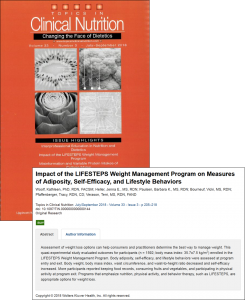
The study was published in the July/September 2018  Topics in Clinical Nutrition: “Impact of the LIFESTEPS Weight Management Program on measures of adiposity, self-efficacy, and lifestyle behaviors” by Woolf, Kathleen, PhD, RDN, FACSM; Heller, Jenna E.,MS, RDN; et al.

The study evaluated measures of adiposity, self-efficacy, and lifestyle behavior in 1592 participants from 13 states enrolled in LifeSteps®.

Special thanks to Kathleen Woolf, PhD, RDN, FACSM. Dr. Woolf is an associate professor and director of the nutrition PhD program at New York University; and previously an associate professor in the Health Sciences department at Arizona State University.

LifeSteps® is a behaviorally-based lifestyle change program that can enhance your practice. Click here to learn more about LifeSteps®.

Results:

Measures of Adiposity

Mean weight, BMI, waist circumference and waist-to-height decreased significantly between the initial and final assessments for those completing the LifeSteps® program.

Adiposity Measure Initial Final
Mean Weight 98.2 ± 23.3 kg 95.0 ± 23.0 kg, p<0.001
BMI 35.7 ± 7.5 kg/m2 34.5 ± 7.5 kg/m2, p<0.001
Waist Circumference 108.8 ± 15.3 cm 104.7 ± 15.1 cm, p<0.001
Waist-to-height ratio 0.66 ± 0.09 .63.0 ± .09 , p<0.001
Measures of Self-Efficacy

Participants reported greater self-efficacy for weight management and physical activity upon completion of the program and self-efficacy was positively associated with percent weight-change.

Self-Efficacy Initial Score Final Score
For Weight Management 12.9 ± 3.1 14.0 ± 3.1, p<0.001
For Physical Activity 13.5 ± 3.3 14.1 ± 3.4, p<0.001
Lifestyle Behaviors Most Helpful for Weight Loss

After completing LifeSteps®, 754 participants completed the post-assessment questionnaire and identified three behavior strategies most helpful for weight management from a potential list of 15.  Responses were analyzed for three groups based on the amount of weight lost. The top five selected overall were ‘keep food records’ (n=480 [63.7%]), ‘measure serving sizes’ (n=303 [40.2%]), ‘do aerobic exercise’ (n=300 [39.8%]), ‘record calories’ (n=297 [39.4%]), and ‘eat a variety of foods’ (n=192 [25.5%]).

Top Three Helpful Lifestyle Changes for Weight Loss
Helpfulness < 5 pound weight loss  (n=433) 5-10 pound weight loss  (n=254) >10 pound weight loss (n=55)
Most Helpful Keep food records (n=266, 61%) Keep food records
(n=167, 66%)
Keep food records
(n=39, 71%)
Second-most Helpful Measure servings
(n=170, 39%)
Record calories
(n=112, 44%)
Do aerobic exercise
(n=33, 60%)
Third-most Helpful Record calories
(n=155, 36%)
Measure serving sizes
(n=107, 42%)
Record calories
(n=27, 49%)

Read the complete study here: Impact of the LIFESTEPS Weight Management Program on Measures of Adiposity, Self-Efficacy, and Lifestyle Behaviors  or it can be obtained through Topics in Clinical Nutrition website.

Enhance your Practice

If you’re not teaching LifeSteps®, you’re missing out on a valuable tool. Find out how this program can help you boost your business, and help your clients change their lives.

Filed Under: News Tagged With: Behavior change, behavioral, BMI, dietitian, Food diary, health, LifeSteps, lifestyle change, modification, obesity, research, self-efficacy, Topics in Clinical Nutrition, weight management

Primary Sidebar


Why Small Groups

Target Audience

Sample Lesson

Leader Training

Want More Information?

Training and Program Package: $845

Everything you need to get your small group started!

Leader Training

Online self-study training course

Leader Materials

  • User Guide
  • Session Lesson Plans
  • Materials for Lessons

Participant Materials

  • Personal Plan Notebook
  • Self-Assessments
  • Eat the MyPlate Way
  • 18 Food and Activity Record booklets

Ready to boost your business and start the program?

Get started now!

Payment due after application approval

© 2026 · LifeSteps | Website design by String Marketing

Need more details about the LifeSteps® program?

This brochure is an overview of the program that you can bring to management and decision-makers to help build your LifeSteps® business.

Download brochure.

30LM-LifeSteps Leader-Mktg-2018
Leader and Participant Material Samples

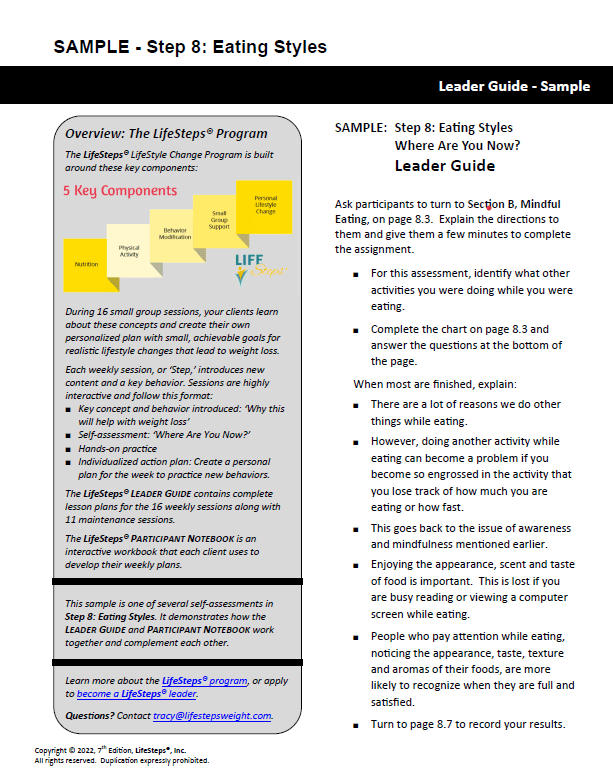
Sample: Step 8 Eating Styles – Mindful Eating Assessment

View/Download

Step8-Sample.png
Want More Information?

Are you an RDN or health professional interested in learning more about LifeSteps®?

Get our Program Overview.


Interested in participating in a LifeSteps® group? Contact us…

Need more details about the LifeSteps® program?

This brochure is an overview of the program that you can bring to management and decision-makers to help build your LifeSteps® business.

Download brochure.

Leader Training

What You’ll Learn

The course covers everything you need to know to launch a successful LifeSteps® program.  It:

  • Develops your skills in behavioral techniques, behavioral feedback and group management.
  • Certifies you to deliver LifeSteps® in a variety of setting, including worksites, private medical practices, fitness centers and wellness and bariatric clinics.
  • Provides RDNs with 15 CPEs that can be completed on your schedule, in your home or office.

      Course Objectives: After completing the Leader Training, you will be able to:

  • Identify all components of the LifeSteps® Weight Management Program.
  • Know how to use each component effectively.
  • Apply cognitive-behavioral strategies and group facilitation skills in a weight management setting.
  • Understand when and how to provide behavioral feedback to clients.
  • Apply goal setting concepts to specific client situations.
  • Function as an independent contractor of the LifeSteps® Weight Management Program.
  • Market and promote the program.

What’s Included

Both course options include the following:

  • Required, background reading
  • PowerPoint presentations
  • “Hands on” assignments using the LifeSteps® program materials
  • Review through quizzes and tests
  • Idea sharing

How It Works

If you’re qualified to become a LifeSteps® Leader, choose from two options:

  • Scheduled Course – Join in and interact online with others who are taking the course at the same time.
  • Individualized Self-study – This is a great option if scheduled course dates don’t work for you. Contact tracy@lifestepsweight.com for more information.

The course is taught entirely online.  All you need is:

  • A computer
  • An internet connection and
  • 6 weeks to complete the LifeSteps® Leader Training Course!

No matter which option you choose:

  • You complete the course at your own pace, on your own time, in the convenience of your home or work setting.
  • The course is open and available for you 24/7.
  • There is no set time to log-in and you can work when it fits your schedule.
  • Plan for about 3 hours per week to complete the tasks.

How Do I Start?  Apply to Be a Leader

We are proud to say it! “Not just anyone can teach LifeSteps®! 

Only Registered Dietitian Nutritionists (RDNs) and qualified health professionals can become LifeSteps® Leaders.”  It’s what sets LifeSteps® apart from other weight management programs and one way we maintain the integrity and quality of the program.

All non-RDN applicants must demonstrate ongoing continuing education in nutrition through workshops, seminars, conferences, etc. within the last 5 years and meet one of the following criteria:

  • Hold a degree in nutrition from an accredited college or university, OR
  • Hold a 4-year degree in a related health field and have completed a minimum of one college-level course in human nutrition, OR
  • Hold a 4-year degree in a non-related field, have 5 years’ work experience in a health-related field, and have completed a minimum of one college-level course in human nutrition from an accredited college or university within the past 5 years.


(CDR #LS001)

LifeSteps®  is a Continuing Professional Education Accredited Provider through the Commission on Dietetic Registration

Leader Requirements

We are proud to say it! “Not just anyone can teach LifeSteps® !”

Only Registered Dietitian Nutritionists (RDNs) and qualified health professionals can become LifeSteps® Leaders.  It’s what sets LifeSteps® apart from other weight management programs and one way we maintain the integrity and quality of the program.

Non-RDN Applicants:  All non-RDN applicants must demonstrate ongoing continuing education in nutrition through workshops, seminars, conferences, etc. within the last five years and meet one of the following criteria:

  • Hold a degree in nutrition from an accredited college or university, OR
  • Hold a 4-year degree in a related health field and have completed a minimum of one college- level course in human nutrition, OR
  • Hold a 4-year degree in a non-related field, have five years’ work experience in a health-related field, and have completed a minimum of one college-level course in human nutrition from an accredited college or university within the past five years.

Intellectual Property Rights

All applicants who are accepted into the course must sign and return a LifeSteps® Leader Agreement that outlines LifeSteps® intellectual property rights.

Accredited Provider

LifeSteps®  is a Continuing Professional Education Accredited Provider through the Commission on Dietetic Registration (CDR #LS001).

Target Audience

LifeSteps® is appropriate for a wide ranging audience of people who want to lose weight for any number of reasons. It’s for people…

  • With medical conditions, such as prediabetes or diabetes, hypertension, knee and joint issues, sleep apnea or any condition where losing weight – even small amounts – can make a big difference.
  • Who suffer from “diet burnout” and have tried numerous diets without success.
  • Who simply want to look and feel better.

Readiness Is Key

Regardless of the motivation for losing weight, a person has to be READY for LifeSteps®.  It is for the individual who WANTS to lose weight for personal reasons, not because someone has told them they “should” or “need” to lose weight.

They have to be willing to:

  • Commit to healthy, moderate eating habits and regular physical activity.
  • Be accountable and keep daily food and activity records.
  • Attend LifeSteps® classes and be part of a group that can support them.
  • Commit to healthy, realistic weight loss goals and take the weight off slowly.
  • Challenge their current attitudes and beliefs about food, physical activity and weight.
  • Engage family, friends and others who will support their lifestyle changes.
Why Small Groups

LifeSteps® is designed for groups of 10-18.  This size allows for a healthy combination of discussion, content review, sharing, accountability and group support.  This size group is small enough to provide personal contact that supports successful behavior change, but big enough for dynamic and robust interaction.

Why Leaders Like Them

  • Cost and time effective
  • Fun and enjoyable to facilitate
  • Participants come up with answers and solutions, too
  • Two-way learning – The leader learns from the group and the group learns from the leader
  • Problem solving and accountability that is not available with one-on-one counseling
  • Peer modeling that makes your job easier and has a profound impact on the entire group

Why Participants Like Them

  • Everyone shares the common goal of lifestyle change and weight loss
  • Everyone works on similar challenges
  • Participants benefit from the shared experience and learn from others in the group
  • They’re “part of something bigger”
  • Find new support and feel understood knowing they are not alone in this challenge
  • Motivate and empower one another